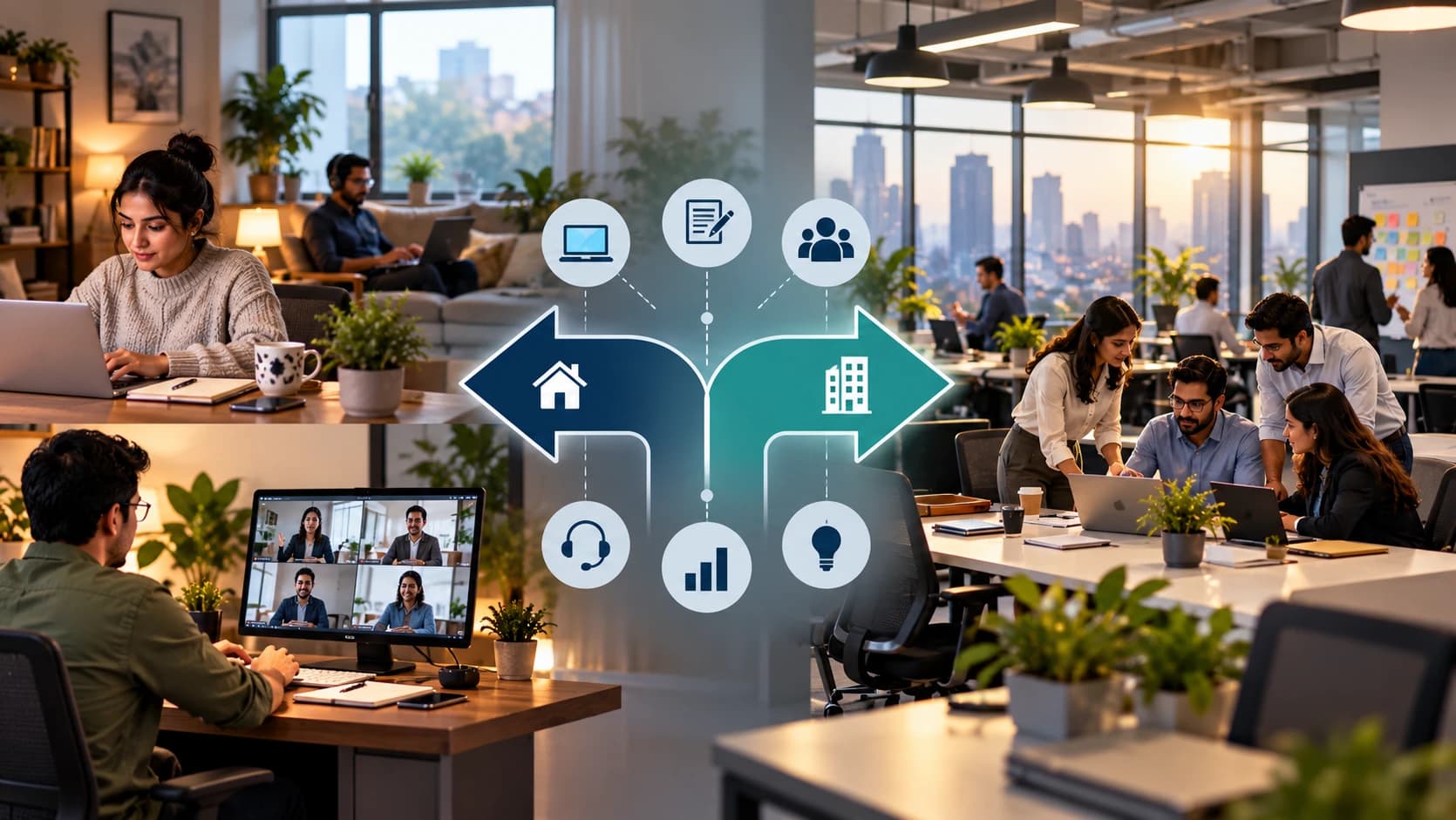
For years, organizations have approached workplace design with a simple assumption: if employees are working, they should be in the office. Physical presence became a proxy for productivity, collaboration, commitment, and managerial control. The office was not merely a place where work happened; it was the default setting for almost every work activity.
The emergence of hybrid working has challenged this assumption. Organizations have discovered that many activities can be performed effectively from home, while others benefit significantly from face-to-face interaction. Employees can prepare reports, analyse data, conduct virtual meetings, and complete focused assignments remotely. At the same time, complex problem-solving, relationship building, creative collaboration, onboarding, and certain learning activities may benefit from physical interaction.
Yet many organizations continue to implement hybrid work through a fixed number of office days, blanket attendance requirements, or department-wide mandates.
This raises a fundamental question: Should organizations decide how many days employees must come to the office, or should they first determine which activities genuinely require physical presence?
The distinction is important. Hybrid work should not begin with a calendar. It should begin with an understanding of work.
The Problem with the Traditional Approach to Hybrid Work
When organizations introduce hybrid working, the first discussion often revolves around attendance.
Should employees work from the office three days a week? Should Mondays and Fridays be remote? Should every employee follow the same schedule? Should managers have the authority to call their teams to the office whenever required?
These questions focus on the logistics of hybrid work rather than its underlying purpose.
A blanket policy may bring employees together, but it does not guarantee meaningful collaboration. Employees may commute to the office only to spend most of the day attending virtual meetings, responding to emails, or working independently at their desks.
Conversely, employees who work remotely may miss opportunities for informal learning, spontaneous discussions, mentoring, and relationship building.
The problem is not necessarily the number of office days. It is the absence of a clear connection between workplace presence and the nature of the work being performed.
Bringing people to the office is an attendance decision. Bringing people together for a specific business outcome is a work-design decision.
Organizations need to move from attendance-led hybrid working to activity-led hybrid working.
Start with the Work, Not the Workplace
Every role consists of multiple activities, and these activities do not have identical workplace requirements.
Consider the work performed by an HR professional. Preparing a payroll reconciliation, analysing attrition data, drafting a policy, conducting a sensitive employee discussion, facilitating a leadership workshop, and onboarding a new employee are fundamentally different activities.
It would be difficult to justify one universal workplace rule for all of them.
Similarly, a finance professional may need uninterrupted time to analyse financial statements, while a finance manager may need to meet business heads to discuss budget variances. A software developer may require long periods of focused work, while a product team may benefit from bringing several specialists together to resolve a complex design problem.
The appropriate workplace depends on the activity, the level of interdependence, the tools required, the sensitivity of the information, and the outcomes expected.
This is why organizations should assess work at the activity level rather than classifying entire jobs as either office-based or remote.
The relevant question is not simply, “Can this employee work from home?”
It is: “Which activities in this role require physical presence, which can be performed remotely, and under what conditions will each be most effective?”
The Four Categories of Work in a Hybrid Organization
A practical starting point is to classify work activities into four categories.
1. Focused Work: Best Suited to Individual Concentration
Examples: Data analysis, report writing, financial modelling, coding, documentation, policy drafting and research.
These activities generally require concentration, continuity, and limited interruption. For many employees, working remotely can provide a suitable environment for completing them.
The office can also support focused work when appropriate facilities are available, but commuting to a shared workplace solely to perform tasks that could be completed effectively elsewhere may offer limited additional value.
Organizations should assess the actual working environment, employee preferences, data-security requirements, and the need for specialist equipment before deciding where focused work should take place.
The principle is straightforward: provide employees with the environment that enables them to deliver quality work efficiently.
2. Collaborative Work: Best Suited to Purposeful Interaction
Examples: Brainstorming, cross-functional problem-solving, strategy workshops, complex project reviews and innovation sessions.
Collaboration is often cited as the strongest argument for bringing employees back to the office. However, collaboration does not automatically improve simply because people occupy the same building.
Effective collaboration requires a shared objective, relevant participants, preparation, and a suitable format.
Some discussions work well through video conferencing and collaborative digital tools. Others benefit from whiteboards, physical prototypes, rapid exchanges of ideas, and the ability to read non-verbal cues.
The objective should be to identify the interactions that genuinely benefit from co-location and organize office time around them.
Instead of asking employees to attend the office every Tuesday, an organization could schedule a project workshop on Tuesday because a decision needs input from engineering, sales, finance, and operations.
The office then becomes a destination for meaningful collaboration rather than a compulsory location for routine work.
3. Relationship and Development Work: Best Suited to Human Connection
Examples: Mentoring, leadership coaching, onboarding, team integration, capability development and sensitive conversations.
Some of the most valuable workplace experiences occur through interactions that are difficult to schedule formally.
New employees learn not only from training sessions but also from observing colleagues, asking spontaneous questions, understanding organizational norms, and receiving informal feedback.
Managers may also find in-person conversations useful when building trust, discussing sensitive issues, or coaching employees through complex challenges.
However, physical presence alone does not guarantee these outcomes. A new employee can spend an entire week in the office without receiving meaningful guidance, while a well-designed remote onboarding programme can provide considerable support.
Organizations should therefore identify where in-person interaction adds value and ensure that the interaction is deliberately designed.
The goal is not merely to bring people together. It is to create opportunities for learning, trust, and professional development.
4. Presence-Dependent Work: Work That Requires a Specific Physical Environment
Examples: Manufacturing, laboratory testing, physical inspections, equipment maintenance, handling certain physical documents and operating location-specific infrastructure.
Some activities cannot be performed remotely because they require specialized equipment, physical materials, secure facilities, or direct interaction with products and customers.
For these activities, the workplace requirement is determined by the nature of the task rather than by managerial preference.
Even here, organizations can examine which supporting activities can be performed remotely. A manufacturing professional may need to be on-site for equipment inspection but may be able to complete documentation, analyse production data, or prepare reports from another location when operational requirements permit.
The objective is to distinguish the activities that genuinely require physical presence from the supporting work that does not.
A Practical Framework for Deciding What Needs the Office
Organizations can make better hybrid-work decisions by evaluating each major work activity against a consistent set of criteria.
| Decision criterion | Key question |
|---|---|
| Physical dependency | Does the activity require equipment, materials, facilities, or physical presence? |
| Collaboration intensity | Does it require rapid, complex interaction among multiple people? |
| Learning and relationship value | Would in-person interaction materially improve mentoring, trust, or knowledge transfer? |
| Focus requirements | Does the activity benefit from uninterrupted individual concentration? |
| Information security | Can the work be performed safely using approved systems and environments? |
| Business impact | What measurable benefit would office presence create for this activity? |
The assessment should consider the actual work context. For example, sensitive employee relations matters may require a private setting, but that setting does not always have to be a corporate office. Similarly, a complex workshop may benefit from physical presence, whereas a routine status meeting may not.
Each activity can then be assigned a preferred work mode: office-based, remote, or flexible depending on the task and circumstances.
Importantly, these categories should not become permanent labels. Technology, team structures, customer requirements, and the nature of work may change over time. Periodic reassessment is therefore essential.
From Office Attendance to Outcome-Based Work Design
Once activities have been classified, the next step is to redesign the way work is organized.
Consider a cross-functional team working on a new product launch. The team includes members from marketing, sales, finance, technology, and operations.
Under a conventional hybrid policy, each employee may be required to attend the office three days a week, irrespective of the team's immediate requirements. Their office days may not overlap, and the team may continue conducting most discussions virtually.
Under an activity-led model, the team identifies the activities that would benefit from co-location.
- Individual research, financial analysis, content preparation, and documentation can be completed remotely where appropriate.
- A product-design workshop is scheduled as a shared in-person session.
- Cross-functional decision meetings are planned around key milestones.
- Routine updates are shared asynchronously through common digital platforms.
- Progress is reviewed against agreed deliverables, deadlines, quality standards, and business outcomes.
This approach does not eliminate office attendance. It makes office attendance purposeful.
It also encourages managers to shift their focus from monitoring presence to ensuring that employees have the resources, clarity, coordination, and support needed to perform effectively.
The Role of Managers: From Supervising Presence to Enabling Performance
Hybrid work requires a change in managerial behaviour.
In a traditional workplace, managers may rely heavily on visibility to assess whether work is progressing. Employees who are physically present can appear more accessible or engaged, even when their actual contribution is no greater than that of colleagues working remotely.
In a hybrid environment, this approach becomes unreliable.
Managers need to establish clear expectations, define deliverables, maintain communication, provide feedback, and address performance issues using evidence rather than assumptions about location.
This requires clarity on:
- What needs to be delivered and by when.
- Which activities require coordination or physical presence.
- How team members will communicate and share information.
- How decisions will be documented and communicated.
- How performance, quality, and accountability will be assessed.
- How employees will access support, mentoring, and development opportunities.
The objective is not to remove managerial oversight. It is to make oversight more effective and less dependent on physical visibility.
A well-designed hybrid system allows managers to understand progress through defined outcomes, regular reviews, and reliable information while preserving opportunities for meaningful human interaction.
The Hidden Risk: Creating Two Different Employee Experiences
One important challenge in hybrid working is the possibility that employees who attend the office more frequently receive greater access to senior leaders, informal discussions, important assignments, and career opportunities.
This can create an unintended divide between employees who are frequently visible and those who work remotely more often.
Organizations need to ensure that hybrid arrangements do not disadvantage employees because of their work location.
Performance assessments should be based on contribution and agreed expectations. Important information should be accessible to all relevant team members. Meetings should be designed so that remote participants can contribute effectively, and development opportunities should not depend solely on physical proximity to decision-makers.
Managers should also monitor whether certain groups of employees have systematically different access to flexibility, visibility, and advancement opportunities.
A fair hybrid model is not necessarily one in which every employee follows an identical schedule. It is one in which workplace arrangements are based on legitimate work requirements, applied transparently, and managed without arbitrary disadvantage.
How Should Organizations Implement Activity-Led Hybrid Work?
A successful transition requires more than revising an attendance policy. It calls for a structured review of work, operating processes, managerial practices, and performance measures.
Step 1: Map Activities Across Roles
Identify the significant activities performed by each function and role. Distinguish routine individual work from collaborative, relationship-intensive, and physically dependent activities.
Avoid making decisions based only on job titles or departmental assumptions.
Step 2: Assess Workplace Requirements
Evaluate each activity using physical dependency, collaboration needs, focus requirements, information security, learning value, and expected business outcomes.
Involve employees and managers in the assessment, as they often understand the practical requirements of the work best.
Step 3: Design Work Modes and Team Rhythms
Define which activities are best performed in the office, remotely, or through a flexible arrangement. Establish shared office days or in-person sessions where coordination genuinely benefits from co-location.
Make exceptions and operational requirements clear so that flexibility does not create confusion.
Step 4: Establish Performance and Communication Systems
Define deliverables, deadlines, accountability, meeting practices, documentation standards, and review mechanisms. Equip managers to lead distributed teams and evaluate outcomes consistently.
Step 5: Pilot and Measure
Test the proposed model within selected teams or functions before organization-wide implementation.
Measure relevant indicators such as delivery timelines, work quality, employee experience, collaboration effectiveness, customer outcomes, and the time and cost associated with commuting and office use.
Where possible, compare results with a credible baseline and account for changes in workload, staffing, seasonality, and other factors that may affect performance.
Step 6: Refine the Model
Use employee feedback and performance evidence to identify what works, what creates friction, and which activities need a different arrangement.
Hybrid work should be treated as an evolving operating model rather than a permanent policy designed once and left unchanged.
Measuring Whether Hybrid Work Is Actually Working
An organization should not evaluate its hybrid model solely through office attendance, employee satisfaction, or the number of remote days.
These indicators may be useful, but they do not provide a complete picture.
A more balanced measurement framework can include:
- Productivity: Achievement of agreed deliverables, output quality, and cycle time.
- Collaboration: Effectiveness of cross-functional decisions, project coordination, and resolution of dependencies.
- Employee experience: Engagement, perceived flexibility, access to support, and work-related wellbeing.
- Talent outcomes: Retention, onboarding effectiveness, development opportunities, and perceived fairness.
- Business performance: Customer service, operational reliability, innovation milestones, and relevant financial outcomes.
- Workplace effectiveness: Utilization of office space, travel requirements, and the value generated by in-person activities.
The measures should reflect the purpose of the hybrid arrangement. A manufacturing team, a technology function, and a customer-facing sales team will not necessarily require the same indicators.
The goal is to establish whether the selected work model is delivering the intended outcomes and where adjustments are needed.
The Final Thought: The Office Should Be Designed Around Work
Hybrid work is not simply a compromise between working from home and working from the office. It is an opportunity to reconsider how organizations structure activities, enable collaboration, develop people, and measure performance.
The office continues to have an important role. It can provide a shared environment for complex collaboration, relationship building, learning, and activities that require physical infrastructure. But its value should come from what employees can accomplish there, not merely from the number of people occupying it.
Similarly, remote work should not be treated as an automatic benefit or a universal solution. It should be evaluated in relation to the work being performed, the outcomes expected, and the conditions required for success.
The most effective hybrid organizations will be those that understand the difference between work that requires presence and work that requires performance.
At Holistic Human Resource Services (HHRS), we believe hybrid working should be approached as an organizational design and business transformation exercise. It requires an understanding of work activities, role requirements, operating processes, performance expectations, technology, leadership practices, and employee experience.
The objective is to help organizations design work arrangements that balance business effectiveness with employee flexibility while maintaining accountability and organizational cohesion.
The future of hybrid work will not be determined by how many days employees spend in the office. It will be determined by how intelligently organizations decide where work happens, how people collaborate, and what outcomes they deliver.
Because the real question is not whether employees should come to the office.
It is: What is the office uniquely enabling them to do?